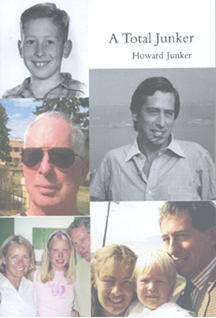
I start publishing in The Nation.
I start analysis.
My mother is operated on for breast cancer.
On November 11, the Daily News reports that Tuesday’s blackout trapped lots of people in elevators and that one of the “219 separate incidents of elevator rescues” was performed by three young men who had reported to their local Civil Defense office, including “Howard Junker, 25, of 340 E. 55th St., writer….”
Andy Warhol, Movie Maker
…Some weeks later, I saw Andy shoot his first sound film, a remake of award-winning Harlot with superstar Mario Montez in the title role. In attendance were a New York producer, the owner of a London gallery, an ex-C.B.S. sound man, and a Magnum photographer, as well as Gerry, technical consultant Philip, and a trio of Tangiers-type poets who huddled out of camera range, preparing to speak the sound track.
As soon as Mario had finished dressing, and Philip had figured out how to thread Andy’s new Auricon sound-on-film camera, and as soon as Andy had learned how to turn it on, production went smoothly.
Andy again used permissive enthusiasm as his major directorial device. Gerry smoked. Philip looked toughly at the camera. Mario ate bananas and fluttered her eyes. Carol restrained a white pussy.
Andy remained close to the camera throughout and frequently watched through the view finder, though, of course, he didn’t touch the camera itself.
Andy wanted to keep his actors in position while the magazine was changed, but they rebelled and complained about having to work under professional conditions.
The Nation, February 22, 1965; included in Cinema Nation: The Best Writing on Film from The Nation, 1913-2000. My first paid piece: $35. I was lucky, choosing to send it to The Nation, because the managing editor, Robert Hatch, was also the film critic and, as a middle-of-the-road one, he welcomed my reports from the periphery.
——
The Fight for Prime Time
…with regard to the independently produced documentary, CBS and NBC do not take this kind of show from the outside. At the former weak sister, ABC, the freeze-out is slightly less absolute.
…But if the FCC so desired, it could force the networks to open up to a whole new world of producers—the independent documentary makers. Nobody can be sure they deserve the chance or that they could do the job. But what’s to lose? The network freeze-out has not advanced the art. Network documentary is a wasteland in its own right.
The Nation, March 15, 1965. I was told there were two ways to break into the networks: 1) start in the mail room or as a page or 2) get three years of experience at a newsmagazine. I was too impatient to pursue either option.
——
The Editor As Artist
In his new book, Films Beget Films: A Study of the Compilation Film, Jay Leyda is critical of TV’s “cozy familiarity” with the past. He dislikes its search for “climax and desperate sensation,” its flip or sentimental or pompous commentary which either says too much about the image or ignores it altogether. He dislikes TV’s lazy reliance on stills, its excessive intercutting of stereotypes—reducing the twenties, for example, to Charlestons and race riots.
…In the future, Leyda hopes that artists will take advantage of the infinite amount of material already available on film, that a broader range of subjects, say matters of philosophy and belief, will be treated and that nations such as Mexico, Cuba, Israel, and Brazil will sum up their histories in compilation. Japan won’t be able to: “The U.S. Army of Occupation was quite indiscriminately thorough in its destruction and confiscation of Japan’s film archives.”
The Nation, June 4, 1965. In 1963, one of my classmates at NYU film school was married to (her former teacher) Louis Clyde Stoumen, who’d just won an Academy Award for The Black Fox: The Rise and Fall of Adolf Hitler; in 1957, he’d won one for The True Story of the Civil War—he’d invented a camera that could track and zoom in on still pictures, what came to be know as “The Ken Burns Effect.” I tried my hand with a compilation of family stills and home movies; when I screened a rough cut for my family, I read the narration and the splices kept breaking.
——
LSD: “The Contact High”
…“And tonight,” Leary continued, “we are going to try to turn you on.”
…The psychedelic theater attempts to stimulate multiple levels of consciousness by audio-visual bombardment…[a] barrage of films, slides, kinetic sculpture, strobe lights, tapes, and live actors [in] a “multi-channel media mix.”
These fancy terms are partly a tribute to the University of Toronto’s communications commentator Marshall McLuhan, who takes a prominent place in the philosophical background of the psychedelic theater…
McLuhan argues that media study should concentrate on the effects of the technology on the environment, on social organization and thought, not on the programmatic content the media transmit. “The medium is the message,” says McLuhan, who recalls how the invention of movable type provided universal access to the word and led to secular learning, individualism, nationalism, and the assembly line. These forms, for McLuhan, are based on the model of the line-of-type, which is linear, sequential, and bi-dimensional. In the electronic age, however, the model is circuitry, which offers multiple, simultaneous connections, as in the analog computer, Telstar, and world government.
The Nation, July 5, 1965. My college roommate took part in Leary’s early experiments at Harvard; he warned me: Don’t. I once went to therapy stoned, but I was always too scared to drop acid. I interviewed McLuhan in October, 1964, while working on a presentation by FORTUNE to the National Association of Manufacturers. The best moment of that gig was when I interviewed Philip Johnson and asked if he was ever afraid of falling out the floor-to-ceiling window in his Seagram Building office; no, he replied, and got up and threw himself against the window.